

.jpg)
With the rise of large language models (LLMs) and AI-generated answers, the search landscape is undergoing a profound transformation. While SEO (Search Engine Optimization) remains a fundamental pillar, a new approach is emerging : GEO (Generative Engine Optimization).
At Biggie Group, we believe that understanding both concepts is essential to staying competitive in a world where AI is redefining the rules of visibility. So, SEO or GEO? Complementary or competing? Let’s break it down.
1. SEO and GEO : two approaches, one shared foundation
SEO : definition, principles, and role in visibility
SEO, or Search Engine Optimization, is the traditional method for making content visible on platforms like Google. The goal is to achieve high rankings in search results, the famous “ten blue links”, to drive traffic to a website.
This relies on technical fundamentals such as crawlability and indexation, as well as content strategies built around keywords and search intent.
GEO : optimizing brands for generative AI
GEO focuses on maximizing a brand’s visibility within AI-generated answers from tools like Google AI Overviews, ChatGPT, Bing Copilot, or Perplexity.
Here, the objective is no longer just clicks, it’s being cited or mentioned as a trusted source by AI systems.
A concrete example : if a user asks ChatGPT “What’s the best gift for a 12-year-old girl?”, GEO is about ensuring your brand appears in that answer.
Why SEO and GEO are complementary
As Google’s Danny Sullivan puts it : “Good SEO is good GEO.”
Both rely on strong foundations: clear, structured, user-focused content, and principles of authority and trust (E-E-A-T : Experience, Expertise, Authoritativeness, Trustworthiness).
However, their goals, and their success metrics, are different.
2. SEO vs. GEO: objectives, KPIs, and key metrics
SEO : traffic, conversions, and organic visibility
Traditional SEO focuses on increasing organic traffic and revenue generated from clicks on search engine results pages (SERPs).
- Channel : Traditional search engines
- Objective : Rank high to attract visitors and convert
- Metrics : Traffic, click-through rate (CTR), direct revenue
GEO : AI citations, brand awareness, and share of voice
GEO operates at the intersection of branding and performance. The goal isn’t necessarily an immediate click, but recognition as a reference by AI systems.
- Channel: Generative and conversational platforms (ChatGPT, Google AI Overviews, etc.)
- Objective: Be cited or recommended by AI and generate clicks
- Metrics: In the era of the “great decoupling” (more impressions, fewer clicks), new indicators matter : share of voice, brand mentions, sentiment, and citation rate versus competitors.
Even without a click, an AI mention can significantly impact credibility and indirect conversions.
3. SEO vs. GEO: which strategies for 2026?
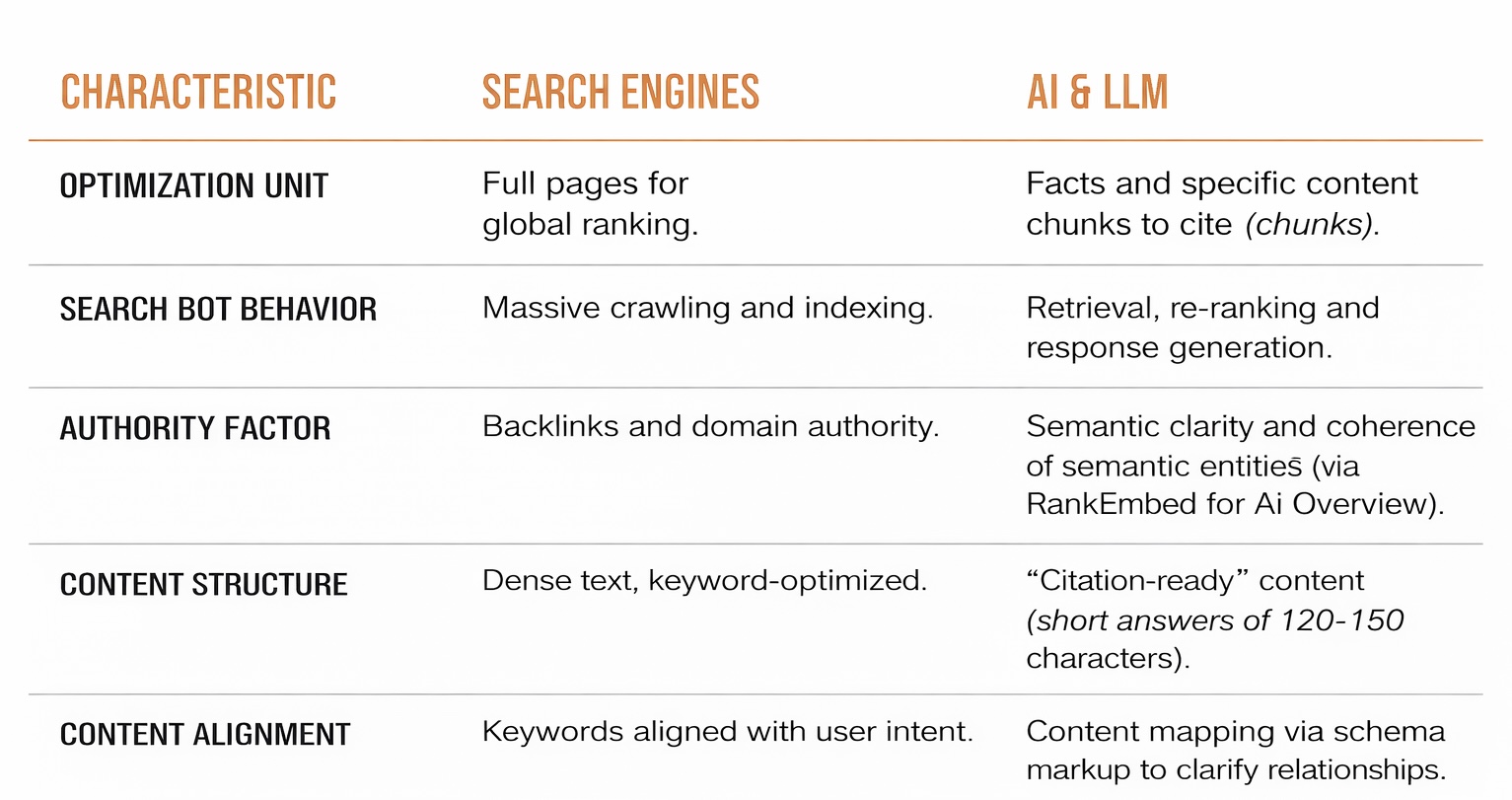
While content quality fundamentals remain the same (E-E-A-T, relevance), SEO and GEO tactics diverge to align with how AI systems interpret and generate answers.
The importance of content for GEO
AI systems break down complex queries into sub-questions using multi-step reasoning. To be cited, content must answer these micro-questions in machine-readable formats : tables, lists, clear definitions, or proprietary data.
For example, an exclusive industry study published by your brand, if well structured, can become a preferred source for AI-generated answers.
Beyond your website : adjacent surfaces
GEO extends beyond owned content. Optimizing your presence on influential third-party platforms, such as Wikipedia, social networks, or press articles, is critical.
These sources often feed AI training data and can significantly strengthen brand credibility and citation potential.
SEO evolves into search everywhere optimization
Alongside GEO, SEO itself is expanding into what’s often called Search Everywhere Optimization.
Search no longer happens only on Google. Users look for answers on social platforms (TikTok, YouTube, Instagram), voice assistants (Alexa, Siri, voice-based ChatGPT), and dedicated apps.
Search Everywhere Optimization means adapting content to be visible across all these touchpoints, respecting each channel’s logic.
For instance, a TikTok video optimized with relevant hashtags may reach an audience that never uses a traditional SERP. Combined with GEO, this approach redefines SEO as a truly omnichannel strategy.
4. SEO and GEO: a complementarity to leverage
SEO and GEO are not opposites, they coexist in everyday user behavior. A user might start with a Google search, then turn to ChatGPT to go deeper.
Brands like Biggie Group must therefore adopt a hybrid strategy :
- SEO to capture organic traffic and direct conversions
- GEO to turn LLMs and AI systems into brand prescribers and conversion drivers
Conclusion: prepare for a hybrid future
AI doesn’t replace SEO, it enhances it through GEO.
While traditional SEO remains essential for driving traffic, GEO becomes a key lever for building authority and visibility in a world dominated by instant answers.
For brands, this means ensuring flawless brand consistency across owned channels and third-party platforms alike.
At Biggie Group, we support our clients through this dual-search transition.
Want to optimize your presence across both traditional and generative engines? Contact us to build a tailored strategy that combines SEO and GEO and positions your brand at the top of SERPs and AI-generated answers alike.
Want to measure your organic visibility across Search Everywhere?
Discover OGGIE here: https://www.oggie.ai/
FAQ : SEO vs. GEO key questions
What’s the difference between SEO and GEO ?
SEO optimizes websites for Google rankings. GEO optimizes brands to be cited in AI-generated answers.
Does GEO replace SEO ?
No. GEO complements SEO. GEO targets AI responses, while SEO remains essential for traffic and conversions.
How can brands be cited by ChatGPT or Google AI Overviews ?
By publishing clear, structured content with data, lists, definitions and reusable elements that AI systems can easily leverage.


